


7 Signs Your Child May Need Reading Support

7 Signs Your Child May Need Reading Support This School Year
Hello, families!
The time has officially arrived. Summer vacation is ending or for some of you, it has already ended.
I know many of us are asking for just a few more weeks of summer because, let's be honest, are we truly ready for the five-day-a-week packed lunches, drop-off lines, and the twice-a-week phone calls of, "James has a cough?" 😂
Aside from all of that, there's a bigger question we should be asking:
Does my child need reading support this school year?
The academic expectations have kicked up a notch. There are new teachers, new routines, and new expectations that our children now have to get accustomed to.
So, once again:
Is my child really ready?
Before I start listing signs for you to dive into, there's something important you should know: your child does not have to be failing reading to need additional support.
Many of the earliest signs of a reading gap can actually be pretty easy to overlook.
Here are seven signs I want you to pay attention to this school year:
1. Reading aloud sounds difficult or choppy.
Listen to your child read.
Are they reading smoothly, or are they stopping frequently?
Developing readers will naturally encounter unfamiliar words. However, frequent pauses, guessing, repeatedly sounding out the same types of words, or difficulty maintaining a natural reading pace may indicate that foundational reading skills still need strengthening.
2. Your child avoids reading ALL THE TIME.
Do any of these phrases sound familiar?
"I don't want to read."
"Can you read it to me?"
"This is boring."
Believe it or not, sometimes those statements really do mean your child would simply rather be doing something else.
But sometimes avoidance is a response to difficulty.
When reading requires tremendous effort, children may begin avoiding situations that make them feel unsuccessful.
3. They can read the words but don't understand what they read.
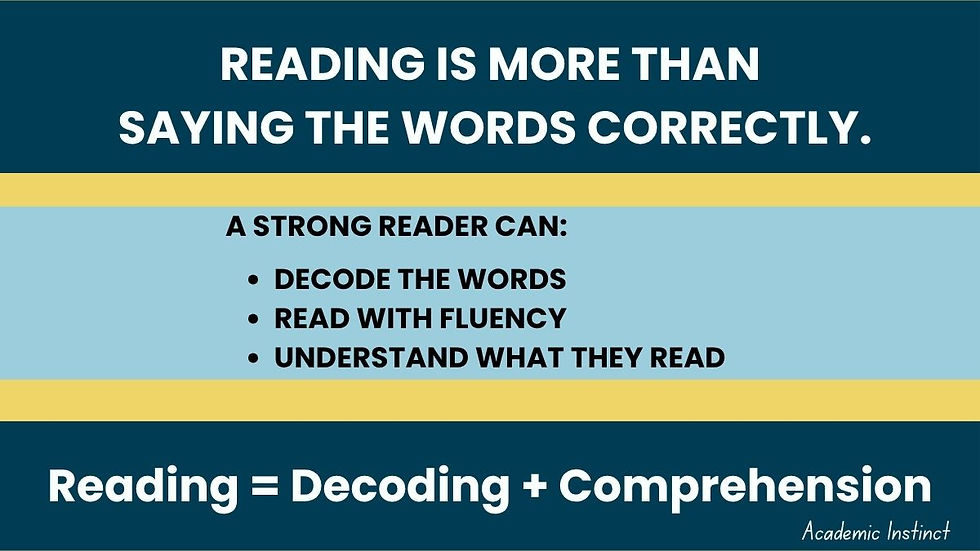
Reading is more than saying words correctly.
A child may read an entire passage beautifully and still struggle when asked:
What happened?
Why did it happen?
What was the main idea?
What evidence supports your answer?
Strong reading requires both decoding and comprehension.
4. They frequently guess unfamiliar words.
Watch what happens when your child reaches a word they don't recognize.
Do they look at the first letter and guess?
Skip the word?
Replace it with another word that kind of makes sense?
These behaviors can signal weaknesses in decoding and word-analysis skills.
5. Writing is significantly harder than speaking.
Ask your child to tell you about their favorite game and you might get a five-minute story.
Ask them to write about it and suddenly you get:
"I like games."
Sound familiar? 😂
Writing requires students to organize ideas, construct sentences, spell, use grammar and punctuation, and communicate clearly all at once.
A noticeable gap between what your child can explain verbally and what they can express in writing deserves attention.
6. Homework regularly ends in frustration.
Homework shouldn't be effortless, but it also shouldn't consistently result in tears, arguments, shutdowns, or hours spent completing assignments that should take significantly less time.
Sometimes the behavior you're seeing may actually be communicating:
"This is harder for me than I know how to explain."
And that's worth paying attention to.
7. Your child is entering the new school year already behind.
Reading skills build on one another.
If foundational gaps remain unresolved, increasing grade-level expectations can make those gaps more noticeable over time.
That's why identifying where the difficulty begins is so important.
If there's one thing I'd like you to take away from this, it's this:
Don't guess. Assess.
If you're concerned, have an assessment done. Talk with your child's teacher. Ask questions about what they're seeing in the classroom and where your child may need additional support.
And if you aren't able to get the answers you need, reach out to us here at Academic Instinct.
We don't believe in simply telling a family,"Your child needs tutoring."
We first want to understand why they're struggling.
Because the goal isn't simply more practice.
It's the right support.
Start the school year with clarity. 💙
— Arima Martinez
Co-Founder & CEO, Academic Instinct


Comments